Denver Building Installs “Blue Chirper” Device to Deter Homeless Loitering
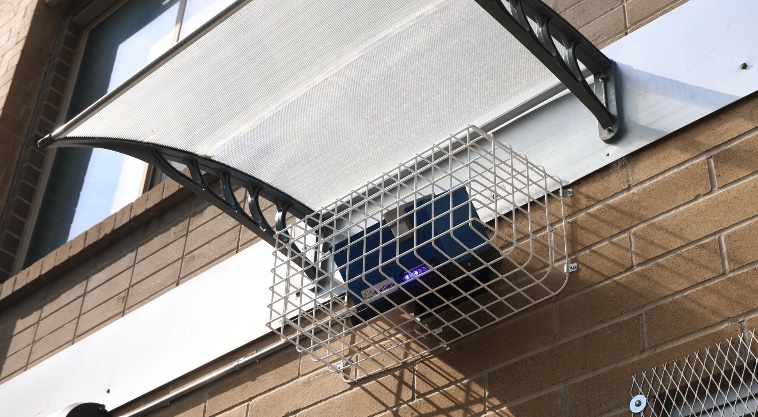
In Denver’s Ballpark district, a small blue cube has appeared on the side of the Curtis Street Lofts, part of a growing trend in “hostile architecture” aimed at deterring homelessness in urban areas. Known as the Blue Chirper, the device is mounted high on the building, protected by an awning and cage. Equipped with a motion sensor, it activates when someone approaches, flashing a blue strobe light and emitting a constant cricket-like chirping sound designed to annoy and drive people away.
The Curtis Street Lofts installation is the only one currently in Colorado, though the device has been used elsewhere. Its inventor began developing the Blue Chirper in 2023 and has since produced over 150 units, fulfilling dozens of orders each month. The strobe effect is intended to resemble police lights, while the blue hue is also thought to discourage intravenous drug use.
The Ballpark neighborhood is home to several homeless service providers, including the Colorado Coalition for the Homeless and Denver Rescue Mission, making it a common gathering spot for unhoused residents. In recent years, property owners in the area have introduced measures like metal spikes, planter boxes, and parking blocks to prevent encampments. The Blue Chirper adds a new layer to these strategies, joining a list of unconventional deterrents used nationally, such as loud music or opera played outside businesses.
While some residents and property owners see the device as protection against loitering and drug activity, advocates for the unhoused describe it as dehumanizing and ineffective. Observations in late August showed the Blue Chirper chirping repeatedly while groups of people remained nearby, suggesting limited impact on dispersing individuals.
Denver has made progress reducing large homeless encampments, but smaller gatherings remain common in areas like Curtis Street. The addition of devices like the Blue Chirper reflects the tension between property owners seeking control of their spaces and the ongoing visibility of unhoused residents in the city’s core.